DevOps & CI/CD Automation
Deploys should be boring — a merge, a green pipeline, and a rollback you’ve already proven works.
Audit our pipeline ↗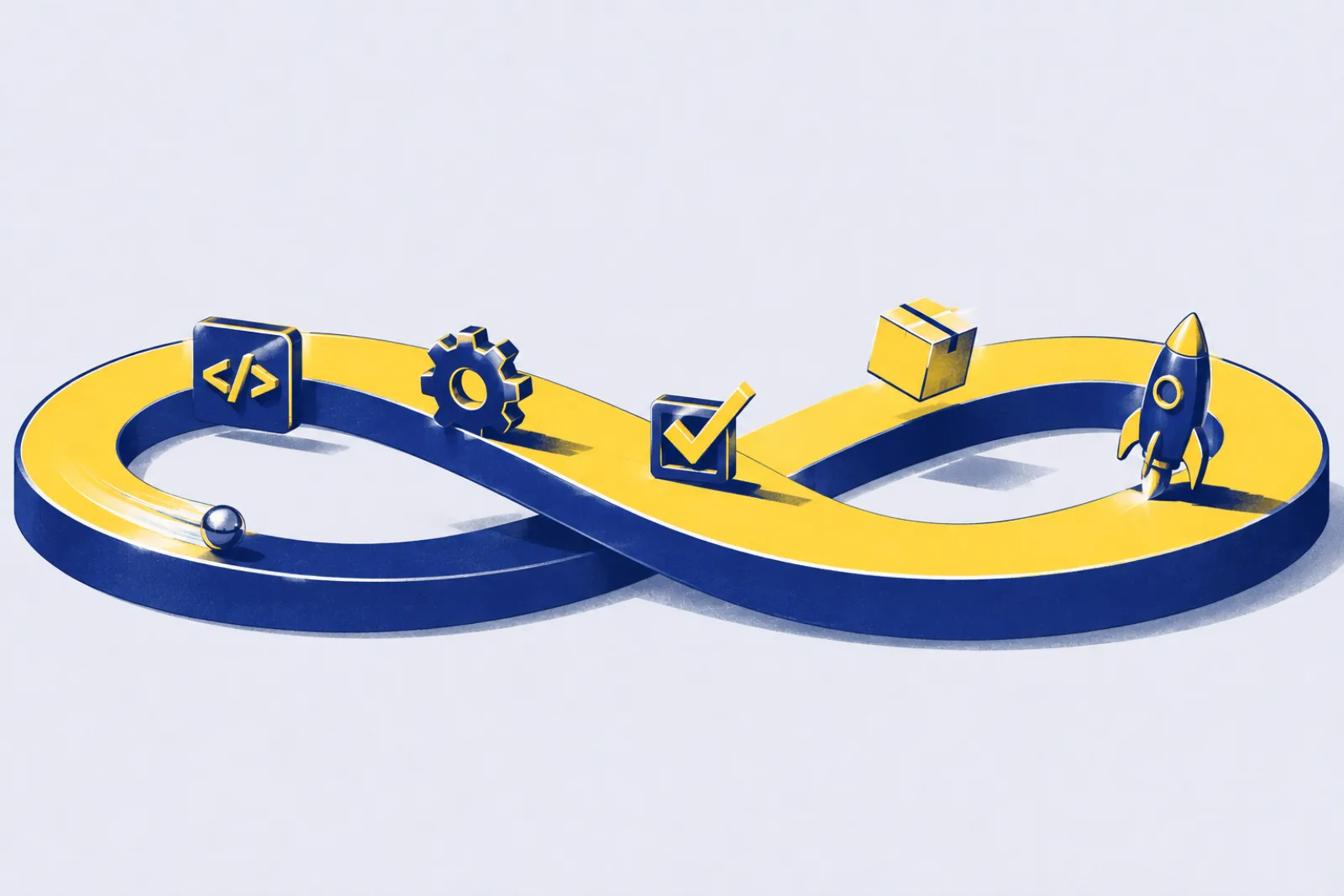
What does good CI/CD actually look like?
CI/CD is two habits rather than one tool. Continuous integration means every push gets built and tested against the same rules, so the main branch is always releasable. Continuous delivery means getting that build in front of users is a decision someone makes, not a project someone schedules.
The measure that matters isn’t how many stages your pipeline has — it’s how long a one-line fix takes to reach production, and how confident you are undoing it at 6pm on a Friday. If a release needs a spreadsheet, a code freeze, or one specific person who is on holiday, the pipeline isn’t finished yet.
What we put in place
Pipeline build-out
Build, test, lint and deploy stages in GitHub Actions or GitLab CI, cached and parallelised so people wait for them rather than route around them.
Environments in code
Dev, staging and production defined in Terraform so they actually match, and a throwaway environment can be stood up per branch.
Test gates that earn it
The checks that genuinely catch regressions wired into merge. Flaky tests get fixed or deleted, never retried on a loop.
Reversible releases
Blue/green or canary rollout with health checks and automatic rollback, so a bad build affects a slice of traffic for ninety seconds.
Secrets and access
Short-lived credentials issued via OIDC instead of long-lived keys pasted into CI settings and forgotten about.
Alerts worth waking for
A small set of alerts tied to user-visible symptoms, plus dashboards someone will actually open during an incident.
How the work runs
Time the current loop
We measure your real path from commit to production, count the manual steps, and read what broke in the last three months.
Fix the slowest gate
One change first, usually build caching or test parallelism, because a pipeline nobody trusts to be quick gets bypassed.
Codify the environments
Staging and production move into Terraform and stop drifting apart, with the differences between them made explicit and deliberate.
Make releases reversible
Staged rollout, health checks and a one-command rollback — then we deliberately break a deploy in staging to prove it comes back.
Hand it to your team
Pairing sessions, written runbooks, and a review of who can deploy. The goal is that the next change to the pipeline is yours.
DevOps & CI/CD Automation FAQ
A pipeline and environment engagement typically runs $8k–$25k depending on how many services and environments are in scope. The initial assessment is fixed-price and standalone, so you get the findings even if you do the work yourselves.
The tools we build with
We choose tools your own engineers can debug at 2am over anything that demos beautifully and then hides its failures.
Pipelines & delivery
 GitHub Actions
 GitLab CI
 Argo CD
 CircleCI
 Jenkins
Infrastructure as code
 Terraform
 Pulumi
 Ansible
 Helm
HelmRuntime & platform
 Docker
 Kubernetes
 AWS
AWS Nginx
NginxTests & monitoring
 Vitest
 Prometheus
 Grafana
 Datadog
 Sentry
Related work



Related reading


Dreading your next deploy?
Tell us how a change reaches production today, manual steps and all. We’ll come back with the three fixes that would cut that time most, in order.